Listen to this article
Paper Wealth — Why Elon Musk Doesn't Have $869 Billion in Cash
The Budget Mate | Financial Education Series
This article provides an overview of how wealth is calculated, the difference between paper net worth and realisable cash, and the economic effects of wealth liquidation. It is not financial advice or a recommendation. For personal financial advice, consult a qualified financial advisor.
Elon Musk has crossed the $1 trillion mark — and you all got upset. Because you don't understand basic concepts about how money and the economy work.
Bloomberg declared him the world's first trillionaire in 2026 [1]. The internet erupted. "Eat the rich." "Tax the wealthy." "Nobody needs that much money." The outrage was instant, loud, and completely misinformed.
This is not a fluff piece for Elon Musk. We have no idea if he's a good or a bad person. We're here to discuss money, the economy, and basic concepts the school system failed to teach you.
So let's start with a simple thought experiment.
If Elon Musk decided today he'd had enough — wanted to turn all his assets into cash and retire — he wouldn't have $1 trillion. He wouldn't even have $869 billion. Not even close.
Don't get confused: he wouldn't end up poor. He'd still be extremely rich. But $1 trillion? $869 billion? Not happening. Not by a long shot.
Here's why — and why understanding the difference matters to you.
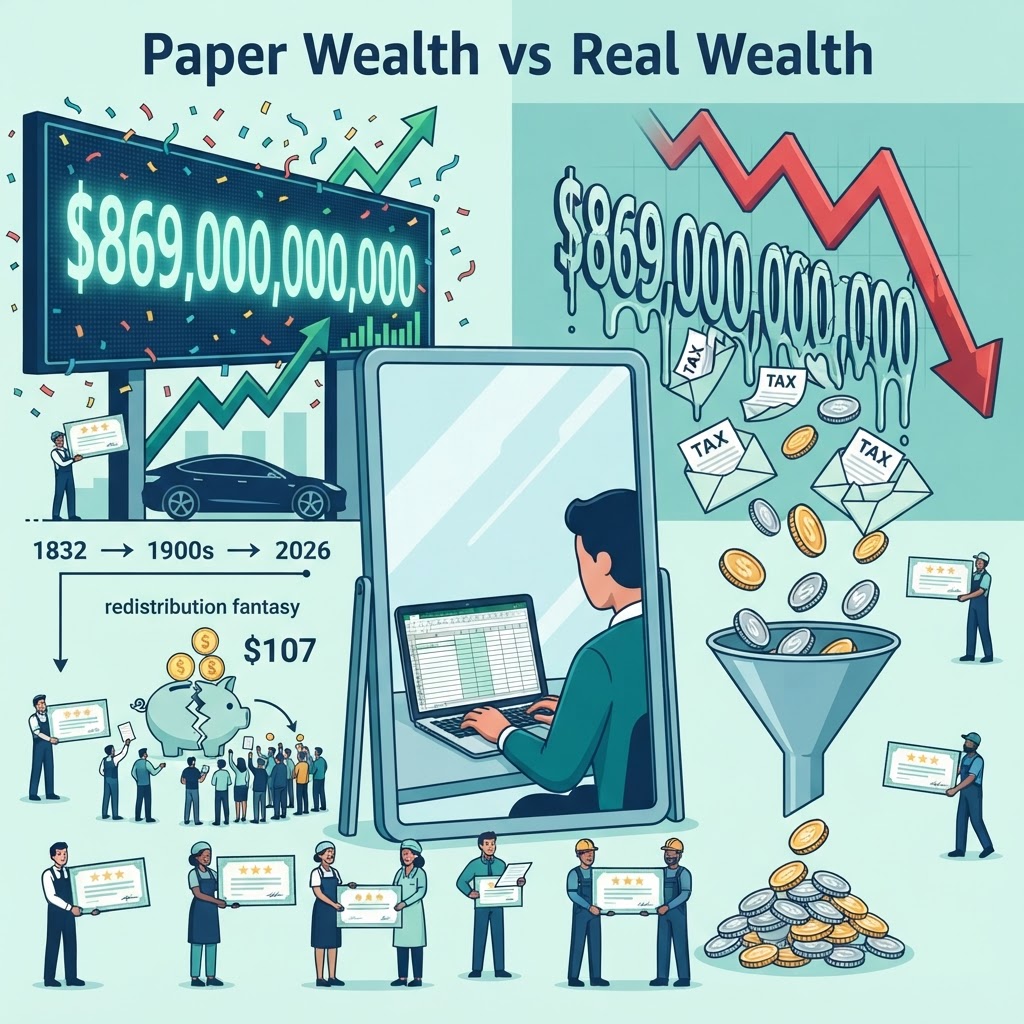
The $869 Billion Illusion
As of August 2026, Bloomberg's Billionaires Index values Elon Musk's net worth at approximately $869 billion [1]. Forbes places him at roughly $839–864 billion [2]. He's widely described as the world's first trillionaire — a label that sounds staggering but reveals a fundamental misunderstanding about what "net worth" actually means.
Musk's wealth is not sitting in a bank account. It's not in a vault. The vast majority of it is shares — ownership stakes in Tesla, SpaceX, xAI, and other ventures. A share price is not a direct measure of a company's worth. It's a measure of supply and demand — how many people want to buy versus how many want to sell at any given moment [3].
If Musk tried to sell all his shares at once, he would flood the market with supply. And when supply massively exceeds demand, prices don't just drop — they collapse. As Investopedia notes, block trades of significant size "can significantly impact market prices if not handled privately and appropriately" [4]. Legal experts at Steptoe & Johnson confirm: "The sale of large block of stock will typically depress the market price of the underlying stock" [5].
We've already seen a preview of this. In 2022, Musk sold approximately $40 billion in Tesla shares over roughly 14 months to finance the Twitter (now X) acquisition [6]. During that period, Tesla's stock fell by approximately 28% [7]. That wasn't entirely due to his selling — broader market conditions played a role — but the selling pressure was a significant factor. A lawsuit later alleged that Musk improperly sold more than $7.5 billion in Tesla shares, contributing to the price decline [8].
Now imagine not $40 billion, but his entire holding — sold all at once. The market would be flooded. Bidders would pay cents on the dollar. The share price would crater, and the very wealth he was trying to realise would evaporate as he sold.
Financial analysts estimate that a liquidation event of that scale could destroy 70–90% of the share value before the selling was even complete [4][5]. His $869 billion could become $80–170 billion — before taxes.
And Then He'd Pay Tax
Here's the part the "eat the rich" crowd always forgets: wealth on paper is pre-tax.
If Musk sold his shares, he'd owe US federal long-term capital gains tax. For 2026, the top long-term capital gains rate is 20%, plus a 3.8% Net Investment Income Tax (NIIT) for high earners — a combined federal rate of 23.8% [9][10]. Musk relocated to Texas, which has no state income tax [11].
The tax is on the gain, not the total value. Musk's cost basis — what he originally paid — is relatively low, since he founded or co-founded most of these companies. That means most of the sale proceeds would be taxable gains.
Assuming his cost basis is 5–10% of current value, he'd owe roughly 23.8% on 90–95% of the realised amount. On a hypothetical $869 billion, that's approximately $197–207 billion in federal tax [9][10].
Combine the market crash with the tax bill, and Musk's $869 billion "net worth" could realistically shrink to $100–130 billion in actual cash. Still enormous. Still more than anyone needs. But nowhere near $869 billion — and certainly not a trillion.
This is true for everyone on the Forbes and Bloomberg lists [1][2]. The numbers you see are paper valuations based on current market prices. The wealth is real in the sense that the shares exist and have value. But it's not real in the sense of "money in the bank you can spend." It's a theoretical number that assumes you could sell at today's price — which you can't, not in volume.
The Cascading Collapse
But let's say Musk went ahead with it anyway. What would actually happen to the economy?
Tesla employs approximately 134,785 people globally as of 2025 [12]. SpaceX employs approximately 22,000 people [13]. Combined, that's roughly 156,000+ jobs — real people with real families, real mortgages, real health insurance tied to their employment.
If Musk liquidated and the share prices collapsed, both companies would face existential crisis. Board members, lenders, partners, and customers would lose confidence. Credit ratings would be downgraded. Financing for future projects would dry up. In a worst-case scenario, tens of thousands of people would lose their livelihoods.
And it wouldn't stop there:
- Mineral and steel industries: Tesla is one of the world's largest consumers of lithium, nickel, cobalt, aluminium, and steel. A Tesla collapse would hammer mining companies and metal suppliers globally.
- Shipping and transportation: Thousands of logistics companies, ports, and freight operators depend on Tesla's and SpaceX's supply chains.
- Component manufacturers: The automotive supply chain is deeply interconnected; a collapse of a major automaker drags down hundreds of suppliers.
- Car dealerships and service centres: Tesla's direct-to-consumer model still employs thousands in sales, service, and delivery.
- Energy sector: Tesla Energy (Megapack, Powerwall, solar) is a major player in grid-scale battery storage. Its collapse would slow the renewable energy transition.
Then there's the tax revenue impact. Tesla's global income tax provision was approximately $1.42 billion in 2025 [14]. While the company has controversially paid $0 in US federal income tax in recent years due to loss carryforwards and credits [15], it still pays payroll, sales, property, and international corporate taxes — and its 134,000+ employees pay income tax on their wages.
The loss of 156,000+ jobs would mean lost income and payroll tax revenue, increased unemployment payments, reduced consumer spending in those communities, and reduced corporate tax from a weakened company.
Before You Hate the Guy
Let's be clear: Elon Musk is just an example. He's someone who created a successful business and, through one of the most basic concepts of business — he provided value — made it big.
Before you hate the guy because someone told you he's evil because he has money, there are a few things worth knowing.
He made his employees rich — even the cafeteria workers.
When SpaceX went public in June 2026, it created approximately 4,400 new millionaires among current and former employees [16][17]. That number included engineers, technicians, administrators — and reportedly even cafeteria workers who had received stock options as part of their compensation packages [16][18].
SpaceX's compensation model — equity for employees at all levels — meant the wealth created by the company's success was distributed far more broadly than most people realise. These aren't just executives getting rich. These are regular workers who became millionaires because they helped build something.
He brought back the electric car.
Electric vehicles aren't new. The first crude electric vehicle was built by Scottish inventor Robert Anderson around 1832 [19][20]. By the late 1800s and early 1900s, electric cars were popular in cities — quiet and clean compared to the hand-cranked gasoline cars of the era [21].
As the US Department of Energy explains: as gasoline cars improved (electric starter, mass production, cheaper fuel) and the petroleum industry grew in power, electric vehicles were pushed out of the market [19]. By the 1920s, they had nearly disappeared. The technology existed for over a century — but was held back not by lack of innovation, but by an industry that had no interest in seeing it succeed.
Musk didn't invent the electric car. But he fought through entrenched industry resistance, proved that electric vehicles could be desirable and high-performance, and made them accessible and widespread. He completely disrupted an automobile industry that had resisted change for a century. Whatever you think of him personally, that impact is real — and it benefits the very people who want to see him brought down.
The Redistribution Fantasy
So what if we just took his money and gave it to everyone? How much would each person actually get?
Let's do the maths.
Musk's net worth: approximately $869 billion [1]. World population: approximately 8.1 billion.
$869 billion ÷ 8.1 billion people = $107 per person.
A one-time payment of $107. That's what "eating the rich" looks like when you actually run the numbers. At the World Bank's extreme poverty line of $3.65/day, $107 lasts approximately 29 days [22]. One month. Then it's gone.
Even redistributing the wealth of all US billionaires — approximately $5.7 trillion combined — works out to roughly $704 per person globally [2]. Still a one-time payment, gone in months.
Limited to the US population (approximately 333 million), Musk's $869 billion would give each American approximately $2,610 — one-time. At a basic living expense of $50/day, that's about 52 days [22].
Now consider this: the world's GDP in 2026 is approximately $126.3 trillion [23]. That's what the global economy produces in a single year — approximately $346 billion every single day. Musk's entire net worth equals approximately 145 days of global economic output.
The point isn't that billionaires shouldn't pay more tax, or that inequality isn't a problem. The point is that redistribution of existing wealth is a one-time band-aid, not a solution. The real engine of prosperity is what the economy produces every year — and that engine is powered by the labour and innovation of the working and middle class, not by raiding the bank accounts of the ultra-wealthy.
What happens when you actually try it?
History is full of governments that tried to confiscate and redistribute wealth. The results are remarkably consistent:
- Venezuela: Seized oil assets, redistributed wealth, imposed price controls. Result: hyperinflation, mass poverty, a collapse from one of South America's wealthiest nations to one where millions fled [24].
- Zimbabwe: Confiscated white-owned farms to redistribute to supporters. Agricultural output collapsed and the currency became worthless — hyperinflation peaked at 79.6 billion percent in November 2008 [25].
- Soviet Union: Abolished private property and redistributed all wealth through the state. The system collapsed after 70 years of economic stagnation, with living standards far below market economies [26].
Economists across the political spectrum — from Milton Friedman to Thomas Piketty — agree that sustainable prosperity comes from productivity growth, not from one-time wealth transfers [27][28]. Piketty, often cited by redistribution advocates, argues for progressive taxation of ongoing income, not confiscation of existing wealth [28]. Taxing income streams is sustainable. Seizing assets destroys them.
The Excuse Industry's Favourite Scapegoat
Here's what's really happening when someone tells you to hate Elon Musk — or any billionaire — because of their wealth.
Demonising an individual for their success doesn't get you anywhere. It feels good. It gives you someone to blame. But it doesn't pay your rent, reduce your mortgage, or increase your salary. It doesn't teach you how to budget, how to invest, or how to manage your cashflow.
Blaming the system and the government feeds the excuse industry. There's an entire ecosystem — politicians, commentators, influencers, activists — that thrives by keeping you frustrated, angry, and feeling powerless [29]. It just gives you someone else to blame.
The same energy spent tweeting about Musk's wealth could be spent tracking your own spending. The same outrage directed at billionaires could be directed at the subscriptions you forgot to cancel, the impulse purchases you can't account for, and the budget you've never actually built.
Stop Chasing Ghosts. Start Tracking Numbers.
Elon Musk's $869 billion doesn't affect your life. Your $4.50 daily coffee that compounds to $1,643/year does. The three streaming subscriptions you forgot to cancel do. The car loan you didn't stress-test before signing does.
Skipping your daily coffee doesn't make you rich — but understanding where your money goes does [30]. Buying a $750,000 apartment on a 5% deposit requires a household income of nearly $200,000 to sustain — and most people sign that mortgage without running the numbers [31]. Share prices are driven by supply and demand, not by how you feel about the person who owns them [3].
The energy spent resenting someone else's paper wealth is energy you could spend understanding your own real cashflow.
The Budget Mate doesn't care about Elon Musk's net worth. It cares about yours.
Track your income. Categorise your expenses. Model your future. Stress-test your decisions. See where your money actually goes — not approximately, not "I think I spend about $200 on food," but actually. Run the numbers before you sign the mortgage. Before you take the loan. Before you make the commitment.
Time to stop making excuses. Time to be responsible and accountable for your situation and finances. Stop getting dragged by the current. Start controlling your life.
The numbers don't care about your feelings. And they don't care about Elon Musk's either. They only care about what you do with your own money — and whether you know where it's going.
The Budget Mate — Track smarter. Spend wiser. Live freer.
References
[1] Bloomberg Billionaires Index (2026). "Elon Musk." https://www.bloomberg.com/billionaires/profiles/elon-r-musk/
[2] Forbes (2026). "The World's Real-Time Billionaires." https://www.forbes.com/real-time-billionaires/
[3] The Budget Mate — Investor Psychology (2026).
[4] Investopedia (2026). "Block Trade Explained: Definition, Process, and Market Impact." https://www.investopedia.com/terms/b/blocktrade.asp
[5] Steptoe & Johnson LLP (2025). "The Government's Next Insider Trading Target: Block Trading." https://www.steptoe.com/en/news-publications/the-governments-next-insider-trading-target-block-trading.html
[6] Cambridge University Press / Finance and Society (2024). "Capitalising on conjunctures: Tesla's ups and downs in financialised capitalism." https://www.cambridge.org/core/journals/finance-and-society/article/capitalising-on-conjunctures-teslas-ups-and-downs-in-financialised-capitalism/004CA3F5233945EA10402713ECC1C830
[7] CNBC (2022). "Tesla stock down 28% since Elon Musk took over Twitter." https://www.cnbc.com/2022/12/13/tesla-stock-down-28percent-since-elon-musk-took-over-twitter.html
[8] ABC7 New York (2026). "Elon Musk accused of improperly selling $7.5 billion in Tesla stock." https://abc7ny.com/post/elon-musk-accused-improperly-selling-75-billion-tesla/14917474/
[9] Tax Foundation (2026). "2026 Tax Brackets and Federal Income Tax Rates." https://taxfoundation.org/data/all/federal/2026-tax-brackets/
[10] Internal Revenue Service (2026). "Net Investment Income Tax." https://www.irs.gov/individuals/net-investment-income-tax
[11] Texas Comptroller of Public Accounts. "Taxes." https://comptroller.texas.gov/taxes/
[12] Tesla, Inc. (2026). "Annual Report on Form 10-K for the Year Ended December 31, 2025." https://ir.tesla.com/
[13] Wikipedia (2026). "SpaceX." https://en.wikipedia.org/wiki/SpaceX
[14] Macrotrends. "Tesla Income Taxes 2012–2026." https://www.macrotrends.net/stocks/charts/TSLA/tesla/total-provision-income-taxes
[15] Institute on Taxation and Economic Policy (2026). "Tesla Reported Zero Federal Income Tax on $5.7 Billion of U.S. Income." https://itep.org/tesla-reported-zero-federal-income-tax-in-2025/
[16] Yahoo Finance (2026). "SpaceX cafeteria workers poised to become millionaires after blockbuster IPO." https://finance.yahoo.com/news/spacex-cafeteria-workers-poised-to-become-millionaires-after-blockbuster-ipo--4400-employees-set-to-hit-7-figures-195500168.html
[17] New York Times (2026). "SpaceX's IPO Could Turn 4,400 Employees Into Millionaires." https://www.nytimes.com/2026/06/10/technology/spacex-ipo-employee-millionaires.html
[18] Fox Business (2026). "How the historic SpaceX IPO is turning everyday workers into overnight millionaires." https://www.foxbusiness.com/markets/how-historic-spacex-ipo-turning-everyday-workers-overnight-millionaires
[19] US Department of Energy (2024). "The History of the Electric Car." https://www.energy.gov/articles/history-electric-car
[20] Wikipedia (2026). "History of the electric vehicle." https://en.wikipedia.org/wiki/History_of_the_electric_vehicle
[21] Edison Tech Center (2024). "Robert King and early electric vehicles." https://edisontechcenter.org/robert-king/
[22] World Bank (2025). "International Poverty Line." https://www.worldbank.org/en/topic/poverty/brief/international-poverty-line
[23] International Monetary Fund (2026). "World Economic Outlook, April 2026." https://www.imf.org/external/datamapper/NGDPD@WEO/OEMDC/ADVEC/WEOWORLD
[24] BBC News (2025). "Venezuela crisis: How the country went from wealthy to collapsed." https://www.bbc.com/news/world-latin-america
[25] Hanke, S.H. & Kwok, A. (2009). "On the Measurement of Zimbabwe's Hyperinflation." Cato Journal, 29(2), 353–364. https://www.cato.org/cato-journal/spring-summer-2009/measurement-zimbabwe-s-hyperinflation
[26] Applebaum, A. (2024). Autocracy, Inc.: Dictators Who Built the Modern World. Random House.
[27] Friedman, M. (1962). Capitalism and Freedom. University of Chicago Press.
[28] Piketty, T. (2014). Capital in the Twenty-First Century. Harvard University Press.
[29] The Budget Mate — The Excuse Industry (2026).
[30] The Budget Mate — The Coffee Myth (2026).
[31] The Budget Mate — The Housing Market Trap (2026).
The Budget Mate is an educational tool, not a licensed financial advisor. Past performance does not indicate future performance. For personal financial advice, consult a qualified financial advisor.
The Budget Mate — Track smarter. Spend wiser. Live freer. Free, secure, no banking connections. thebudgetmate.com